Home › Guides › HVAC & appliances › Furnace not working? No-heat troubleshooting before you call a pro
GuideWhen the heat goes out — especially on a cold night — it's stressful, but a surprising number of no-heat problems come down to a few simple things you can check yourself before booking a pro. Here's a safe troubleshooting order, plus the warning signs that mean stop and get a licensed technician right away.
It sounds obvious, but check the thermostat first: make sure it's set to Heat, the temperature is set above the current room temperature, and the batteries aren't dead (a surprising number of no-heat calls are dead thermostat batteries). If it's a smart thermostat, confirm it's powered and connected.
Confirm the furnace has power — check that its switch (often a regular-looking light switch near the unit) is on, and that the breaker hasn't tripped. Reset a tripped breaker once; if it trips again immediately, stop and call a pro, as that signals an electrical fault, not a simple trip.
A severely clogged air filter can cause a furnace to overheat and shut itself off as a safety measure. If your filter is dirty, replace it — this is a common and easy fix, and a clogged filter is one of the most frequent causes of a furnace that runs but doesn't heat well or cuts out.
Make sure the furnace's power switch is on and, for gas furnaces, that the gas supply is on. If you have a gas furnace and smell gas, leave the home and contact your gas utility immediately — do not troubleshoot a gas smell yourself. That's a safety emergency, not a repair.
Stop and book a licensed HVAC pro for: a breaker that keeps tripping, a yellow (not blue) burner flame, strange smells (especially burning or gas), loud banging or grinding, short-cycling, or if your carbon monoxide detector goes off (leave the home first). These can be safety issues, not just comfort ones.
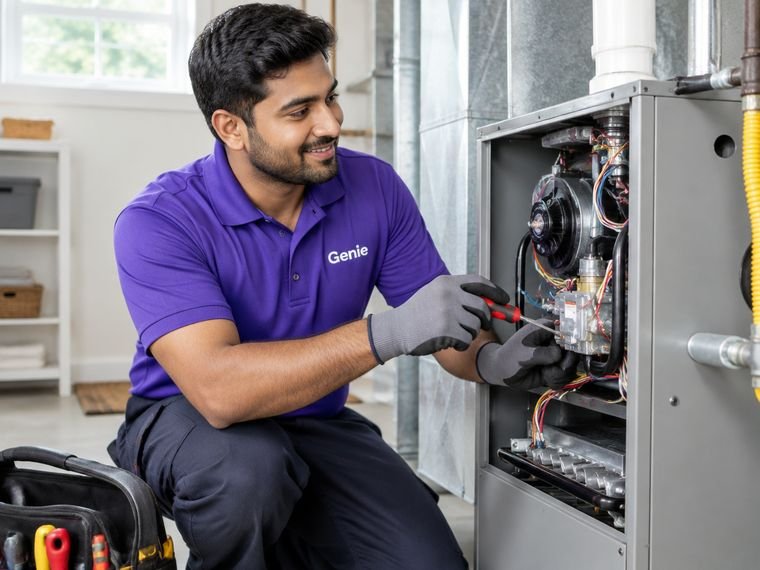
If the simple checks don't restore heat, it's time for a pro — ignition, blower, heat exchanger and control-board issues need a technician. On Genie you can book a licensed, insured HVAC pro at an upfront or quoted price, with payment held until it's fixed. And a fall tune-up each year prevents most mid-winter no-heat calls in the first place.
Every task in this guide is something you can book on Genie — vetted, insured pros at an upfront price:
Common causes include a thermostat set wrong or with dead batteries, a tripped breaker, a severely clogged filter causing overheat shutoff, or the gas/power switch being off. If simple checks don't fix it, a pro should look at the ignition, blower or heat exchanger.
Basic checks (thermostat, breaker, filter, power switch) are fine. But if you smell gas, leave and contact your utility; and a repeatedly tripping breaker, yellow flame, strange smells or a CO alarm mean stop and call a licensed pro.
Book a furnace tune-up every early fall — it catches failing parts before they strand you, and prevents most mid-winter no-heat emergencies. On Genie you can be reminded annually.